
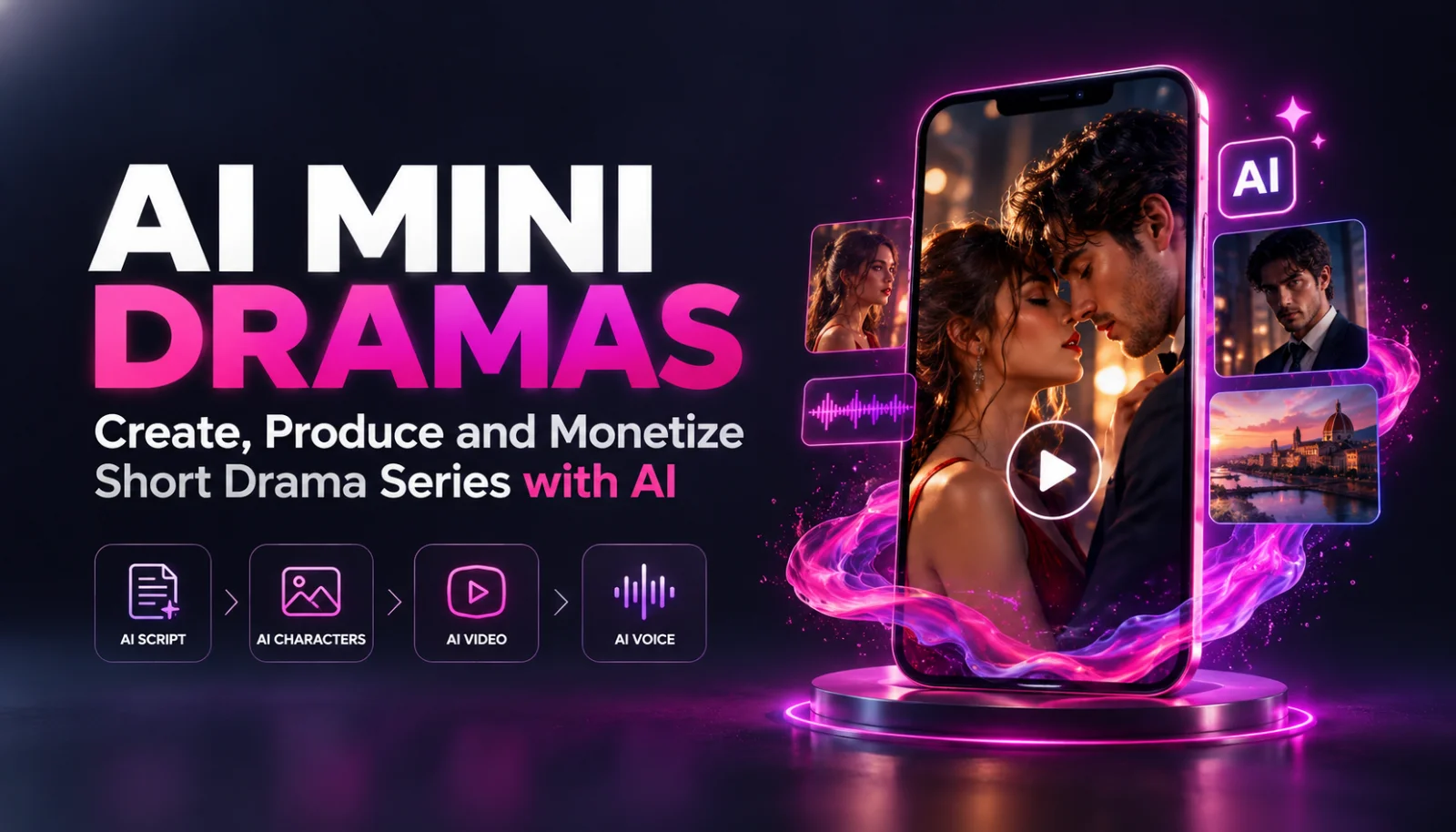
The Rise of AI Mini Dramas: A New Era of Digital Entertainment
Entertainment is changing. Stories are getting shorter, distribution is becoming increasingly mobile-first, and artificial intelligence is transforming how video content is produced.
Welcome to the world of AI mini dramas.
Imagine a complete drama series delivered through 60- to 180-second episodes, featuring compelling characters, emotional storytelling, cinematic visuals, and cliffhangers designed to keep viewers watching.
Now imagine producing that series without traditional film sets, physical locations, or an entire production crew.
With generative AI technologies and creative production platforms like Covely, creators, agencies, media companies, and entrepreneurs can explore a new approach to serialized entertainment.
But AI mini dramas are more than a creative trend. They represent an emerging business opportunity at the intersection of entertainment, artificial intelligence, and digital monetization.
In this guide, we'll explore what AI mini dramas are, how they work, how to create them using Covely, and the business models behind this growing entertainment format.
What Are AI Mini Dramas?
AI mini dramas are short-form scripted video series created entirely or partially using artificial intelligence.
Also known as AI micro dramas, AI short dramas, or AI vertical dramas, these productions combine traditional storytelling techniques with AI-generated characters, environments, video sequences, and audio.
Unlike standalone social media videos, mini dramas follow an ongoing storyline across multiple episodes.
Each episode advances the narrative, introduces new conflicts, and typically ends with a cliffhanger that encourages viewers to watch the next installment.
Key Characteristics of Mini Dramas
- Vertical video format (9:16): Designed primarily for smartphone viewing.
- Short episodes: Typically between 1 and 3 minutes.
- Serialized storytelling: Stories unfold across multiple episodes.
- Strong emotional hooks: Romance, suspense, betrayal, mystery, and dramatic twists.
- Cliffhanger endings: Every episode encourages continued viewing.
- Mobile-first distribution: Optimized for short-form video platforms and dedicated streaming apps.
- Flexible monetization: Advertising, subscriptions, episode unlocking, and premium access.
The format gained significant traction in China before expanding internationally through dedicated platforms such as ReelShort and DramaBox.
Today, generative AI is introducing a new dimension to this market: the ability to experiment with serialized video production using AI-powered creative workflows.
Why Are Mini Dramas Becoming a Business Opportunity?
Mini dramas combine three powerful digital trends:
- The growth of mobile video consumption.
- The popularity of short-form entertainment.
- The monetization potential of serialized storytelling.
Unlike traditional social videos, mini dramas are designed to build a continuing relationship with viewers.
A single episode can attract an audience, while subsequent episodes create opportunities for engagement, retention, and monetization.
This makes the format particularly interesting for:
- Independent creators building original entertainment properties.
- Media companies developing digital content catalogs.
- Creative agencies offering new storytelling formats to brands.
- Startups launching dedicated short-drama applications.
- Entertainment entrepreneurs testing subscription and pay-per-episode models.
- Brands experimenting with serialized branded entertainment.
The opportunity is not simply to generate more videos. It is to create scalable entertainment properties that can attract audiences and generate recurring revenue.
How to Create AI Mini Dramas: Step-by-Step
Traditional video production involves scriptwriters, actors, filming locations, cameras, lighting, editing teams, and post-production specialists.
Generative AI can transform parts of this process by enabling creators to produce characters, scenes, and visual sequences digitally.
Step 1: Develop Your Story and Script
Every successful mini drama starts with a compelling story.
Popular genres include romance, thriller, mystery, fantasy, family drama, and comedy.
The first step is to define the central conflict, main characters, and overall narrative arc.
AI-assisted writing tools can help structure the storyline, develop character profiles, generate dialogue, and divide the narrative into short episodes.
For example, a 30-episode series might feature 90-second episodes, each with a strong opening, a central dramatic moment, and a cliffhanger.
The goal is to create a story that makes viewers want to continue watching.
Step 2: Create Consistent AI Characters
Character consistency is one of the most important challenges in AI-generated storytelling.
A protagonist must remain recognizable throughout the series, maintaining consistent facial features, clothing, personality, and visual identity.
Using Covely's AI image generation capabilities, creators can develop visual references for characters, environments, and key scenes.
These references can then become the foundation for subsequent video generation.
Maintaining visual consistency still requires careful prompting, reference management, and quality control, particularly when working across multiple scenes or models.
Step 3: Generate Cinematic Video Scenes with AI
Once the script and characters are defined, the story can be divided into individual shots and sequences.
Using AI video generation models, creators can transform text prompts or reference images into cinematic video content.
With Covely's multi-model creative environment, production teams can experiment with different generative models depending on the visual requirements of each scene.
These sequences may include:
- Character close-ups and emotional reactions.
- Dialogue-driven interactions.
- Cinematic camera movements.
- Dramatic lighting and environments.
- Action sequences and visual effects.
- Transitions between scenes.
Rather than generating an entire episode in one step, a more controlled approach involves producing individual shots and assembling them into a coherent narrative.
Step 4: Add AI Voices, Dialogue, and Localization
Audio is essential to storytelling.
AI voice technologies can support the creation of dialogue, narration, and multilingual versions of a production.
This opens up opportunities to distribute the same mini drama across different international markets.
A series originally developed in English, for example, could be adapted into Spanish, Italian, French, or other languages.
Localization can help creators expand their potential audience without reproducing the entire visual production.
Step 5: Edit and Assemble the Episodes
After generating the visual sequences, the next step is to assemble them into complete episodes.
This includes editing, pacing, sound design, subtitles, transitions, and final quality checks.
The finished episode should maintain a consistent visual style and deliver a compelling narrative experience.
For mobile-first distribution, the final output will typically use a vertical 9:16 aspect ratio.
How to Create AI Mini Dramas with Covely
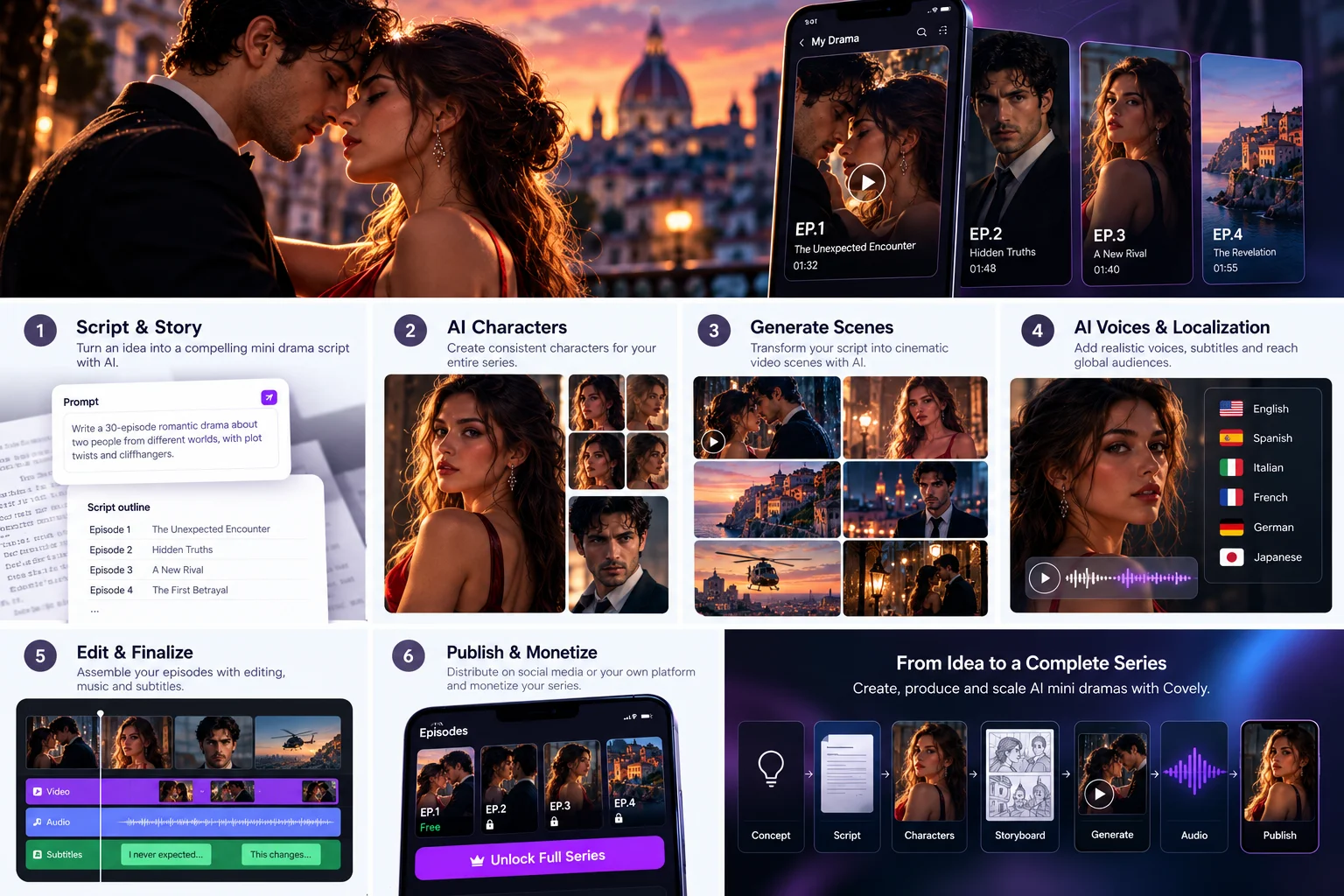
Covely is an AI-powered creative production platform designed to help creators and businesses generate visual content using multiple generative AI models.
For mini drama production, Covely can support a workflow that connects creative development with AI-powered image and video generation.
A Practical AI Mini Drama Workflow
Story Concept → Script → AI Characters → Storyboard → AI Video Generation → Audio → Editing → Distribution
- Define the concept: Start with a storyline, genre, target audience, and episode structure.
- Design your characters: Use AI image generation to create visual references for protagonists, supporting characters, and environments.
- Build a visual storyboard: Create reference images for important moments and define composition, lighting, and visual style.
- Generate video sequences: Use Covely's AI video generation capabilities to transform prompts and reference images into cinematic shots.
- Refine your content: Review generated material, regenerate sequences when necessary, and refine creative direction.
- Complete the episodes: Assemble scenes, add dialogue, sound effects, subtitles, and music, then prepare the final episodes for distribution.
- Scale the production: Reuse visual references, character descriptions, prompt structures, and production guidelines.
Why Use a Multi-Model AI Platform?
Different AI models have different strengths.
Some may perform better with realistic characters, while others may be more suitable for cinematic movement, stylized visuals, or specific creative effects.
Covely's multi-model approach allows creative teams to experiment with different technologies within a broader production workflow.
This flexibility is particularly valuable for serialized content, where consistency, creative control, and production efficiency matter.
AI does not eliminate the need for storytelling expertise, editing, or quality assurance. Instead, it can help automate and accelerate selected stages of the production process.
How to Make Money with AI Mini Dramas: 5 Business Models
Creating AI mini dramas is only the first part of the opportunity. The real business potential comes from developing a sustainable distribution and monetization strategy.
1. Freemium and Pay-Per-Episode
One of the most established monetization models in the short-drama industry is episode unlocking.
Viewers can watch the first episodes for free, but must pay to access the rest of the series.
For example, the first five episodes might be freely available, while subsequent episodes require virtual coins or a direct purchase.
Free Episodes → Viewer Engagement → Cliffhanger → Paid Unlock → Revenue
The success of this model depends heavily on storytelling quality, conversion rates, and customer acquisition costs.
2. Subscription-Based Streaming
Another approach is to build a library of mini dramas and offer access through a monthly or annual subscription.
Subscribers can watch multiple series without purchasing individual episodes.
This model can generate recurring revenue but requires a consistent release schedule, sufficient content variety, and strong audience retention.
3. Advertising and Social Media Monetization
AI mini dramas can also be distributed through platforms such as YouTube Shorts, TikTok, Instagram Reels, and other video networks.
Revenue may come from advertising programs, sponsorships, brand partnerships, or traffic directed toward a dedicated streaming platform.
Creators should review each platform's monetization requirements and policies for AI-generated content.
4. Branded Mini Dramas
Brands can use serialized storytelling to create entertainment-driven marketing campaigns.
Instead of producing a traditional commercial, a company can develop a mini drama where its products, services, or brand values are integrated into the storyline.
This approach combines storytelling with branded entertainment.
For creative agencies, branded mini dramas can become a new service offering, supported by AI-powered production tools such as Covely.
5. AI Mini Drama Production as a Service
Not every company wants to build its own streaming platform.
Some businesses may prefer to commission mini dramas from specialized creative studios or agencies.
This creates opportunities for entrepreneurs to offer AI-powered video production services, including concept development, character design, scene generation, and post-production.
Covely can support the generative creative production component of this business model.
AI Mini Drama Business Model: A Practical Example
Let's imagine producing a romantic mini drama consisting of 30 episodes.
Each episode lasts 90 seconds, resulting in approximately 45 minutes of total content.
The first five episodes are distributed for free to attract viewers. The remaining 25 episodes are available through a paid unlock.
Here's a hypothetical revenue scenario:
| Metric | Example |
|---|---|
| Total episodes | 30 |
| Episode duration | 90 seconds |
| Total content duration | 45 minutes |
| Initial viewers | 100,000 |
| Paying conversion rate | 2% |
| Paying users | 2,000 |
| Average revenue per paying user | $4.99 |
| Illustrative gross revenue | $9,980 |
This is an illustrative scenario, not a revenue forecast. Actual profitability depends on production costs, audience acquisition, payment processing fees, platform commissions, refunds, and other operating expenses.
For a sustainable business, creators should monitor key performance indicators such as:
- Customer Acquisition Cost (CAC): How much it costs to acquire a paying viewer.
- Lifetime Value (LTV): The total revenue generated by each customer.
- Conversion Rate: The percentage of free viewers who become paying users.
- Episode Retention: How many viewers continue watching from one episode to the next.
- Completion Rate: The percentage of viewers who finish each episode.
- Return on Ad Spend (ROAS): Revenue generated relative to advertising investment.
These metrics help determine whether a mini drama can become a repeatable and profitable business.
How AI Can Transform Mini Drama Production Economics
The most important advantage of AI-generated video is not simply the ability to produce content digitally. It is the ability to experiment faster.
Traditional production often requires significant planning and upfront investment before a concept can be tested with audiences.
AI-assisted workflows can enable creators to develop pilots, experiment with multiple storylines, test different visual styles, and produce alternative promotional trailers.
For example, a production company could test three different mini drama concepts before committing to a complete season.
The team could compare viewer engagement, retention, and acquisition costs to identify which concept has the strongest commercial potential.
AI can also help with multilingual adaptation, creative variations, and reusable production assets.
However, actual cost savings depend on the complexity of the scenes, generation quality, model pricing, the number of revisions required, and the amount of human post-production involved.
How to Start Your First AI Mini Drama with Covely
You don't need to produce an entire season to explore this opportunity.
A practical starting point is to create a pilot episode and evaluate the results.
Begin with a simple concept involving two or three characters, a limited number of environments, and a strong narrative hook.
Develop the visual references, generate the key scenes, and assemble a short episode.
Then test the content with a target audience.
Measure how viewers respond, which moments generate engagement, and whether the story creates enough curiosity to justify additional episodes.
Once the production workflow is validated, you can expand into a complete season.
With Covely, creators and production teams can access AI-powered creative generation capabilities to experiment with characters, scenes, and video storytelling.
The opportunity is to move from isolated AI-generated videos to repeatable, scalable content production workflows.
Explore Covely and start creating with AI
Frequently Asked Questions About AI Mini Dramas
What is an AI mini drama?
An AI mini drama is a short-form scripted video series created entirely or partially with artificial intelligence. AI can be used to generate characters, environments, video scenes, dialogue, and other production elements.
How long is an AI mini drama episode?
Most mini drama episodes last between one and three minutes, although there is no universal duration requirement. They are commonly produced in a vertical 9:16 format for mobile viewing.
Can I create an AI mini drama without actors?
Yes. Generative AI can be used to create synthetic characters and environments without filming real actors. However, visual consistency and production quality still require careful creative direction and review.
How do AI mini dramas make money?
AI mini dramas can generate revenue through pay-per-episode access, subscriptions, advertising, sponsorships, licensing, branded entertainment, and production services.
What AI tools do I need to create a mini drama?
A typical workflow includes tools for scriptwriting, AI image generation, AI video generation, audio production, and editing. Covely can support the visual generation stages through its multi-model creative environment.
Can AI mini dramas be published on TikTok and YouTube?
Yes, provided they comply with the platforms' content policies, intellectual property requirements, and applicable AI-generated content disclosure rules.
Is it possible to build a business around AI-generated mini dramas?
Yes, but commercial success is not guaranteed. A viable business requires compelling storytelling, efficient production, effective distribution, and a monetization strategy supported by measurable audience performance.
The Future of AI Mini Dramas
AI mini dramas represent a new intersection of entertainment, technology, and digital entrepreneurship.
As generative AI capabilities evolve, creators may gain greater flexibility to develop original characters, experiment with cinematic storytelling, and produce serialized content for international audiences.
For entrepreneurs, the opportunity extends beyond creating individual videos.
It includes building original intellectual property, developing entertainment catalogs, launching niche streaming services, and offering AI-powered production solutions to other businesses.
The most successful projects will likely combine strong storytelling with efficient production workflows, audience understanding, and sustainable monetization.
The next generation of entertainment may not require a traditional film studio. It may begin with an idea, a compelling story, and the right AI creative tools.
With Covely, creators and businesses can explore this new era of AI-powered visual storytelling.
Your story. Your characters. Your creative vision. Powered by AI.